

Last Updated: October 25, 2026
Quick Summary
To manage pregnancy back pain, combine consistent stretching, proper posture, and supportive sleep positioning with your daily activities. Stretching for 15-20 minutes daily, maintaining good body mechanics, and using integrated belly support during exercise are evidence-backed approaches that help you stay active without pain.
- Cat-Cow Pose, piriformis stretches, and hip flexor stretches should be done 1-2 times daily for 20-30 seconds each.
- Avoid twisting your spine by pivoting with your feet, log-rolling in bed, and turning your whole body when reaching.
- Sleep on your left side with pillows between your knees and under your belly to keep hips aligned and reduce lower back strain.
- Eight of nine studies in a 2026 review found that exercise interventions help prevent and reduce pregnancy-related back pain.
- Call your doctor if you experience severe pain, leg radiating pain, numbness, tingling, or loss of bladder or bowel control.
Table of Contents
- Understanding Pregnancy Back Pain and Why It Happens
- Pregnancy Back Pain Stretches That Provide Relief
- Posture and Body Mechanics for Daily Comfort
- Pregnancy Back Pain Sleeping Positions and Pillow Support
- Safe Pain Relief During Pregnancy
- When to Call a Doctor for Pregnancy Back Pain
- Supportive Activewear and Integrated Belly Support
- Frequently Asked Questions
Understanding Pregnancy Back Pain and Why It Happens
Learning how to manage pregnancy back pain helps many active women keep running, lifting, and staying fit.
During pregnancy, your body releases a hormone called relaxin. This softens ligaments to prepare for delivery.
According to research on pregnancy-related low back pain management, multimodal management combining exercise, education, and activity adjustments is how physiotherapists typically approach this problem.
At Bia and Hera, we work with active pregnant women who refuse to stop moving.
How to Exercise Safely While Pregnant: 7-Step Guide(page:2) covers the broader framework for staying active.
Pregnancy Back Pain Stretches That Provide Relief
The best way to manage pregnancy back pain is through consistent, gentle stretching. Stretching lengthens tight muscles, reduces tension, and improves flexibility.
A 2026 review found that exercise interventions help prevent and reduce pregnancy-related back pain (Exercise Interventions and Pregnancy-Related Back Pain). Eight of nine studies included in the review reported supportive findings for exercise-based approaches, according to research published in the International Journal of Public Health.
The key is consistency. Do these stretches every day, ideally in the morning and evening. Hold each stretch for 20-30 seconds without bouncing. Never push into pain.
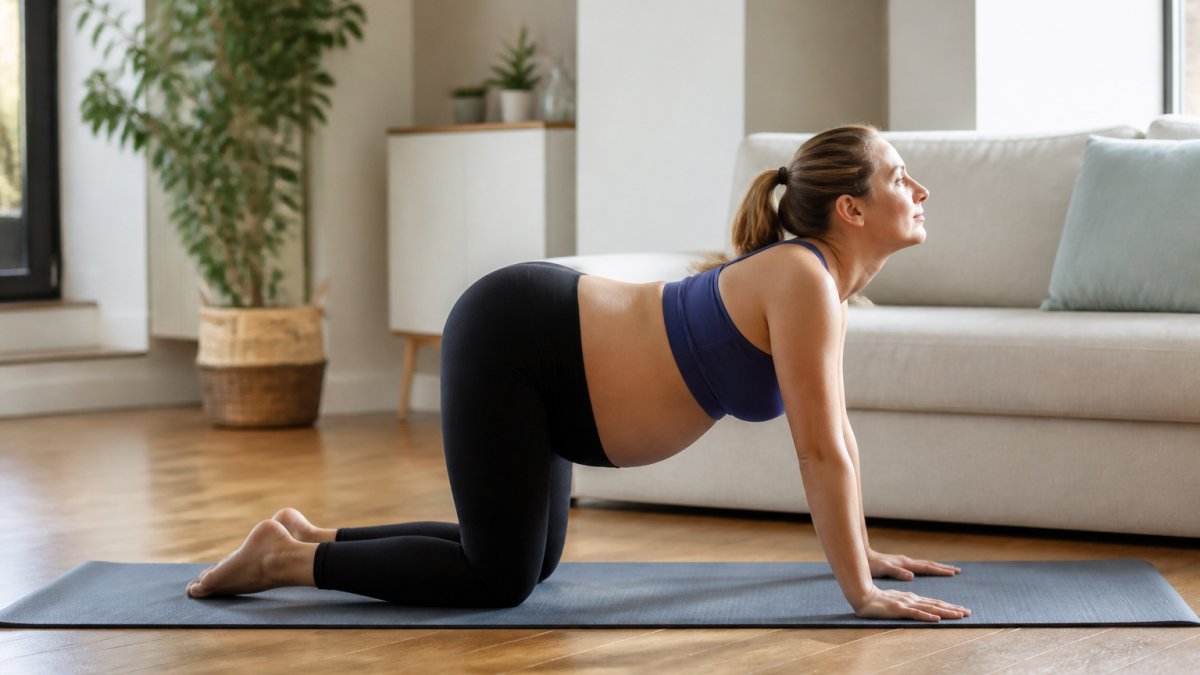
Cat-Cow Pose for Spinal Mobility
Cat-Cow is one of the safest pregnancy stretches. It mobilizes your spine, releases lower back tension, and engages your core gently.
How to do it:
- Start on your hands and knees on a yoga mat or padded floor
- Wrists align under shoulders, knees under hips
- Inhale and drop your belly (Cow): lift your head and tailbone, arch your back gently
- Exhale and round your spine (Cat): tuck your chin, draw your belly in, round your back
- Flow between Cow and Cat for 10-15 repetitions
Do this 1-2 times daily. The gentle spinal movement reduces muscle tension and improves mobility. Many active women find this their most effective pregnancy back pain stretch.
Piriformis and Hip Stretches
Tight hip muscles, especially the piriformis, often contribute to lower back and pelvic pain. Stretching the hips takes pressure off your lower back.
Piriformis stretch:
- Lie on your back with knees bent, feet flat on the floor
- Cross one ankle over the opposite knee, creating a figure-4 shape
- Gently pull your bottom leg toward your chest
- Hold for 20-30 seconds, then switch sides
Hip flexor stretch:
- Kneel on one knee on a padded surface
- Step the opposite foot forward into a lunge position
- Keep your torso upright and gently press your hips forward
- Hold for 20-30 seconds, then switch sides
These stretches target the deep hip muscles that support your lower back. Do both sides, 1-2 times daily.
Standing Extension and Mid-Back Release
Standing extension opens your chest and stretches your mid-back. This counteracts the forward slouch that pregnancy posture creates.
Standing extension:
- Stand with feet shoulder-width apart
- Place your hands behind your head, elbows out to the sides
- Gently arch backward, looking slightly upward
- Hold for 15-20 seconds
- Return to neutral and repeat 5 times
Mid-back stretch:
- Stand and clasp your hands in front of your chest
- Round your spine and push your hands away from your body
- Feel the stretch across your upper and mid-back
- Hold for 20-30 seconds and repeat 3 times
These stretches are especially helpful if you spend time at a desk or hunched over. They open your chest and relieve tension across your entire back.
These stretches target the muscles and areas that contribute most to pregnancy back pain.
| Stretch | Target Area | Duration | Frequency |
|---|---|---|---|
| Cat-Cow Pose | Lower back and spine | 10-15 repetitions | 1-2 times daily |
| Piriformis Stretch | Hip muscles and lower back | 20-30 seconds per side | 1-2 times daily |
| Hip Flexor Stretch | Hip flexors and lower back | 20-30 seconds per side | 1-2 times daily |
| Standing Extension | Chest and mid-back | 15-20 seconds, 5 repeats | Daily |
| Mid-Back Stretch | Upper and mid-back | 20-30 seconds, 3 repeats | Daily |
Posture and Body Mechanics for Daily Comfort
How you move throughout the day matters as much as dedicated stretching. Poor posture amplifies pregnancy back pain, while good posture distributes weight evenly and reduces strain on your lower back.
Core principles of pregnancy posture:
- Keep your shoulders relaxed and back, not hunched forward
- Engage your core gently, think "drawing your belly button toward your spine" without tensing
- Avoid excessive arching in your lower back
Lifting and carrying:
- Squat down with your feet shoulder-width apart instead of bending forward at the waist
- Hold the object close to your body, not extended in your arms
- Avoid twisting your spine; pivot with your feet instead
Sitting at a desk or on the couch:
- Use a pillow or rolled towel behind your lower back for support
- Keep your feet flat on the floor or on a footrest, with knees at or slightly below hip level
- Raise your screen so you are not looking down
Standing and walking:
- Wear supportive, low-heeled shoes to maintain proper alignment
- If you stand for long periods, put one foot on a low step or box and switch sides every few minutes
- Walking is one of the safest activities during pregnancy. It strengthens your legs, improves circulation, and does not stress your back. Aim for 20-30 minutes most days.
Getting in and out of bed:
Arc Maternity Tank with Built-in Belly Band →
- Sit on the edge of the bed, then lower yourself onto your side with your knees bent
- Bring your knees toward your chest and roll onto your back or side as needed, rather than twisting
- To get up, roll onto your side, push up with your arms, and swing your legs over the edge
Getting in and out of a car:
- Open the door wide and sit down first, then swing both legs in together
- Avoid twisting to reach for the seatbelt; turn your whole body instead
When wearing activewear, choose pieces with integrated support. The Arc Maternity Tank from Bia and Hera includes patent-pending built-in belly support that stays in place during movement. This eliminates the need for a separate belly band that rolls up, and it keeps your bump supported without adding bulk.
Pregnancy Back Pain Sleeping Positions and Pillow Support
How you sleep directly affects your morning back pain.
Best sleeping position: Side sleeping is safest during pregnancy.
How to set up your sleep space:
- Lie on your left side (slightly better for circulation, though either side works)
- Place a pillow between your knees to keep your hips aligned
- Add a pillow under your belly for support
- Use a pillow under your head that keeps your neck neutral
- Consider a body pillow for full-length support
This setup prevents your spine from twisting and reduces pressure on your lower back.
Avoid sleeping on your back after the first trimester. Back sleeping reduces blood flow to your baby and increases back pain.
If you wake with back stiffness, gentle morning stretches help.
Safe Pain Relief During Pregnancy
When stretching, posture changes, and sleep support are not enough, safe pain relief options exist.
Heat therapy works well for pregnancy back pain. A warm (not hot) heating pad or warm pack on your lower back for 15-20 minutes reduces muscle tension and improves blood flow. Keep the temperature comfortable and avoid prolonged high heat, since overheating is a concern in pregnancy. Do not sleep with a heating pad on.
Cold packs help if your pain feels acute or inflamed. Apply a cold pack wrapped in a cloth for 10-15 minutes.
Massage and manual therapy can provide relief.
Over-the-counter pain medications require careful consideration.
Physical therapy is highly effective for persistent pregnancy back pain.
Complementary approaches such as prenatal yoga, acupuncture, and chiropractic care are used by some pregnant women, but evidence varies and practitioner experience matters.
When to Call a Doctor for Pregnancy Back Pain
Most pregnancy back pain is manageable with the strategies above. But certain warning signs require immediate medical attention.
Call your doctor if you experience:
- Severe pain that doesn't improve with rest or stretching
- Pain radiating down your leg or into your buttock (possible nerve compression)
- Numbness or tingling in your legs or feet
- Loss of bladder or bowel control
These symptoms may indicate conditions like sciatica, pelvic girdle pain, or other complications that need professional evaluation.
Also contact your doctor if back pain prevents you from sleeping, walking, or performing daily activities. Your healthcare provider can rule out other causes and recommend appropriate treatment.
Supportive Activewear and Integrated Belly Support
The right gear makes managing pregnancy back pain easier.
Traditional separate belly bands often roll up during running or weightlifting, creating frustration.
The integrated support design means:
- No separate band to adjust or replace
- Support stays put during high-impact activities like running
- Flattering fit that works for workouts and everyday wear
- Soft, breathable, moisture-wicking fabric that handles sweat
When your belly is properly supported, your lower back works less hard. This reduces pain and lets you maintain your fitness routine confidently.
Arc Maternity Tank with Built-in Belly Band(page:1) combines the comfort you need with the performance active women expect.
Frequently Asked Questions
What are the most effective stretches to relieve pregnancy back pain?
Cat-Cow poses, piriformis stretches, and gentle hip stretches are among the most effective pregnancy back pain stretches. A 2026 review in the International Journal of Public Health found that eight of nine studies on exercise interventions supported their effectiveness in preventing and reducing pregnancy-related back pain. Perform these stretches for 15-20 minutes, holding each position gently for 20-30 seconds. Always move slowly and stop if you feel sharp pain.
Which sleeping position is safest for managing pregnancy back pain?
Side sleeping with a pillow between your knees is the recommended pregnancy back pain sleeping position for comfort and spinal alignment. This position reduces strain on your lower back and pelvis. Avoid sleeping on your back after the first trimester, as it can restrict blood flow. Use a supportive pillow under your head and consider a full-body pregnancy pillow to maintain alignment throughout the night.
What safe pain relief options are available during pregnancy?
Safe pain relief during pregnancy includes heat packs (15-20 minutes at a time), gentle massage, posture adjustments, and prenatal yoga. Some healthcare providers may recommend acetaminophen for short-term relief. Always consult your doctor before taking any medication or supplement. Conservative, multimodal management, combining education, activity adjustments, and supportive gear, is a common approach among physiotherapists managing pregnancy back pain.
When should I contact my healthcare provider about pregnancy back pain?
Contact your doctor if back pain is severe, accompanied by numbness or tingling in your legs, follows a fall or injury, or does not improve with rest and gentle movement. Seek urgent care if you experience loss of bladder or bowel control, fever, or pain radiating down one leg. Early assessment helps rule out other causes and ensures you receive appropriate support throughout your pregnancy.
Managing pregnancy back pain doesn't mean stopping your workouts or accepting discomfort as inevitable. Consistent stretching, smart posture, proper sleep setup, and supportive gear work together to keep you active and comfortable. Start with the stretches and posture tips this week. If pain persists after two weeks, see a physical therapist. The right approach, combined with activewear designed for athletes, lets you move confidently through all nine months.
