

Last Updated: October 23, 2026
Quick Summary
To exercise safely while pregnant, aim for 150 minutes of moderate activity each week plus muscle strengthening on two or more days, after getting clearance from your healthcare provider. Use the talk test to keep intensity moderate, warm up and cool down for five minutes, and adjust each trimester.
- Get clearance from your provider and ask about limits tied to your specific pregnancy.
- Aim for 150 minutes of moderate activity plus two strength sessions weekly.
- You should be able to hold a conversation during cardio; if not, ease off.
- Warm up for five minutes and cool down for five, skipping neither.
- Lower impact and add pelvic floor work as pregnancy progresses.
Table of Contents
- Start With Your Healthcare Provider, Then Build a Plan
- How Much Exercise During Pregnancy Is Right for You?
- Pregnancy Exercise by Trimester: What Changes and When
- Safe Activities: Walking, Swimming, Lifting, and Prenatal Yoga
- Exercises to Avoid During Pregnancy
- Warning Signs to Stop Exercising While Pregnant
- How to Exercise Safely While Pregnant: 7 Practical Steps
- Frequently Asked Questions
Start With Your Healthcare Provider, Then Build a Plan
Learning how to exercise safely while pregnant starts with one honest conversation.
Here is the part most guides get wrong: the general rule is a starting point, not a prescription. Your provider knows your history, your blood pressure, your placenta, and your risk factors.
So book that appointment. Ask three questions:
- Is my pregnancy low-risk for exercise?
- Are there any movements I should skip?
- What symptoms should send me to the phone?
Write the answers down. You will refer to them in week 30 when you cannot remember what your midwife said in week 12.
How Much Exercise During Pregnancy Is Right for You?
The short answer: aim for 150 minutes of moderate-intensity aerobic activity spread across the week, plus muscle strengthening on two or more days.
A guideline review on physical activity during pregnancy reports that muscle-strengthening activity should happen two or more days per week. The UC Davis Health guidance on exercise in pregnancy sets the aerobic target at 150 minutes weekly.
Sources do not all say the same thing. Cleveland Clinic gives a 120-to-150-minute weekly range, while ACOG and the NHS point to at least 150 minutes.
Guidance Source |
Weekly Aerobic Target |
Strength Work |
|---|---|---|
UC Davis Health (2025) |
150 minutes, moderate |
Not specified in summary |
ACOG and NHS |
At least 150 minutes |
Muscle strengthening included |
Cleveland Clinic |
120-150 minutes |
Not specified in summary |
2014 guideline review |
Moderate activity |
2+ days per week |
If you already train hard, do not double the target. Keep your routine and adjust intensity as your body changes.
Pregnancy Exercise by Trimester: What Changes and When
Pregnancy exercise by trimester is less about hard rules and more about listening to a body that is rebuilding itself in real time. Your energy, balance, and joint laxity shift month to month. The plan should shift with them.
First Trimester: Keep the Routine You Already Have
Most women can continue their pre-pregnancy exercise routine in the first trimester. Fatigue and nausea may cut sessions short, and that is fine. Do what you can on the days you feel good.
Skip hot yoga and any workout that pushes your core temperature high. Keep hydration within reach. If you were lifting before pregnancy, you can generally keep lifting, though your provider may suggest lighter loads as fatigue builds.
Second Trimester: Adjust for Balance and Belly Growth
Balance changes as your center of gravity moves forward. Fall risk climbs, so swap single-leg work on unstable surfaces for grounded versions. Side-lying positions often feel better than flat-on-your-back work after the first trimester.
This is also when support starts to matter. The Strata Maternity Tank with Built-in Belly Band offers patent-pending belly support for movement through this trimester. A maternity workout tank with patent-pending built-in belly support, like the Arc Maternity Tank, keeps the bump steady without a separate band that rolls down mid-set.
Third Trimester: Protect Your Pelvic Floor and Joints
Relaxin loosens your joints, which raises strain risk in late pregnancy. Lower the impact, shorten the sessions, and add pelvic floor exercises to your week. If support is on your mind, our guide to support that moves with you explains how belly support stays put as your shape changes.
Safe Activities: Walking, Swimming, Lifting, and Prenatal Yoga
Safe activities during pregnancy share three traits: low fall risk, steady effort, and easy stopping points. A 2026 paper in PubMed Central's recommendations for lifestyle physical activity in pregnancy lists walking, Nordic walking, swimming, stationary cycling, and jogging as safe options. Jogging is specified for women who already ran before pregnancy.
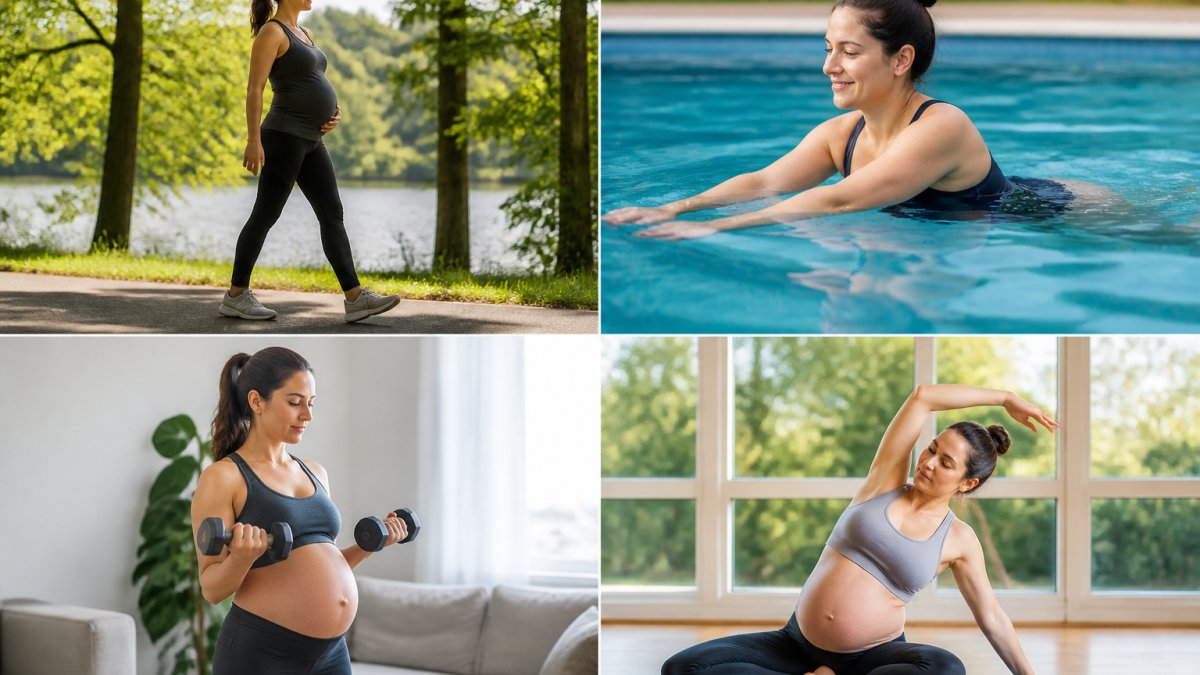
Here is how the main options stack up:
Arc Maternity Tank with Built-in Belly Band →
- Walking: The easiest starting point. Flat routes, supportive shoes, no time pressure.
- Running: Can be continued, if you were running before pregnancy. Maintain an effort where you can carry a conversation.
- Swimming and water exercise: Takes weight off joints and keeps you cool.
- Stationary cycling and elliptical: Low fall risk, steady cardio, easy to stop.
- Strength training: Two or more days per week, with lighter loads and clean form.
- Prenatal yoga and Pilates: Builds balance and breathing control. Skip deep twists and hot rooms.
If you want gear built for these sessions, browse the Bia + Hera maternity activewear collection, which is designed for running, lifting, and stretching.
Exercises to Avoid During Pregnancy
Some movements carry more risk than benefit once you are pregnant. The list below is not about fear. It is about matching the exercise to a body with a shifting center of gravity, looser joints, and a greater need for stable oxygen flow to the placenta.
Here is what to skip, and the mechanism behind each warning:
- Contact sports (basketball, soccer, boxing, hockey): Direct impact to the abdomen is the obvious risk, but even incidental collisions can cause placental abruption or uterine contractions. The trade-off is not worth it, swap for solo shooting drills or passing with a partner who keeps distance.
- Activities with a high fall risk (horseback riding, downhill skiing, gymnastics, road cycling outdoors, ice skating): Your center of gravity shifts forward as the belly grows, and relaxin loosens ligaments, making falls more likely and injuries more severe. Stationary cycling and elliptical trainers give you the cardio without the fall risk.
- Scuba diving: The pressure changes and risk of decompression sickness affect the fetus, and there is no safe depth threshold established for pregnancy. Snorkeling at the surface is generally considered safe, but check with your provider.
- Hot yoga and any class that raises core temperature sharply (Bikram, hot Pilates, intense indoor cycling in a hot room): Maternal core temperature above 102°F (39°C) in the first trimester is associated with neural tube defects. Keep your environment cool and hydrated; if you feel flushed or dizzy, stop.
- Heavy lifting with breath holding (Valsalva maneuver): Holding your breath under a heavy load spikes blood pressure and increases intra-abdominal pressure, which can strain the pelvic floor and worsen diastasis recti. If you cannot talk through a rep, the weight is too heavy for today, lighten the load and exhale on exertion.
The old 140-beats-per-minute heart rate ceiling is outdated, according to National Geographic's reporting on exercise in pregnancy. Newer research looks at how you feel, not just a number on a watch.
If you were a competitive athlete before pregnancy, you may be able to continue some of these activities with modifications under close provider supervision, but that is an individualized decision, not a general rule. When in doubt, substitute a safer alternative that gives you the same training effect: stationary cycling for road rides, swimming for hot yoga, and light resistance training for heavy lifts.
Warning Signs to Stop Exercising While Pregnant
Most women who exercise during pregnancy never experience a serious complication. But knowing when to stop and call your provider is part of safe training.
STOP exercising immediately and call your provider if you experience any of the following:
- Vaginal bleeding or fluid leaking (a gush or steady trickle)
- Regular painful contractions (more than four in an hour before 37 weeks)
- Chest pain, severe shortness of breath, or palpitations
- Dizziness, fainting, or severe headache that will not ease
- Calf pain or swelling (possible sign of deep vein thrombosis)
STOP exercising, rest, and monitor if you experience:
- Mild dizziness or lightheadedness that resolves with sitting and water
- Unusual fatigue that does not improve with rest
- Mild contractions that stop when you rest
- Nausea or vomiting that is not related to morning sickness
If the mild symptoms resolve within 10-15 minutes of rest and hydration, you can resume light activity the next day, but mention it to your provider at your next visit.
When to call emergency services (911 or local equivalent):
- You cannot breathe
- You have chest pain that radiates to your arm or jaw
- You faint or lose consciousness
- You have a seizure
- You experience sudden, severe abdominal pain with or without bleeding
This checklist is not a diagnosis. It is a reason to make a phone call.
How to Exercise Safely While Pregnant: 7 Practical Steps
These seven steps turn the guidance above into a routine you can start this week.
- Get clearance from your provider. Ask about limits tied to your specific pregnancy.
- Set a weekly target. Aim for 150 minutes of moderate activity plus two strength sessions.
- Run the talk test. You should hold a conversation during cardio. If you cannot, ease off.
- Warm up for five minutes and cool down for five. Skip neither.
- Drink water before, during, and after. Overheating is a bigger risk than most women expect.
- Adjust each trimester. Lower impact and add pelvic floor work as pregnancy progresses.
- Check your fit. A supportive tank should stay in place through a full session. The Bia + Hera size chart starts with your pre-pregnancy size.
Frequently Asked Questions
What exercises should be avoided while pregnant?
Skip activities with a high fall risk, like horseback riding, downhill skiing, gymnastics, and contact sports such as basketball or soccer. Avoid hot yoga and exercising in hot, humid conditions because overheating is a concern. Also avoid lying flat on your back for long stretches after the first trimester, deep scuba diving, and any activity that causes pain, dizziness, or vaginal bleeding. If you are unsure whether an activity is safe for your body, ask your healthcare provider before starting.
How much exercise should I get during pregnancy?
Most guidance points to 150 minutes of moderate-intensity activity each week, which works out to about 30 minutes on five days. UC Davis Health OB-GYN providers recommend that 150-minute weekly target, and a 2014 guideline review says muscle-strengthening activity should happen two or more days per week. Cleveland Clinic gives a slightly wider 120-to-150-minute range. Your provider can adjust the number if you have complications or were not active before pregnancy.
When should I stop exercising while pregnant?
Stop and call your provider if you notice vaginal bleeding, fluid leaking, regular painful contractions, chest pain, calf pain or swelling, dizziness, or a severe headache. Shortness of breath before you feel tired, muscle weakness that affects balance, or decreased fetal movement are also reasons to stop. A 2024 BMJ Open Sport & Exercise Medicine article notes that guidelines weigh benefits against risks, so treat any new symptom as a signal to pause and check in rather than push through.
Is it safe to run or lift weights during pregnancy?
For many women, yes. A 2025 University of Alberta study found high-intensity resistance exercise during pregnancy was safe and well tolerated. The 2026 paper Recommendations for Lifestyle Physical Activity and Exercise lists jogging as safe for women who practiced it before pregnancy, along with walking, swimming, and stationary cycling. The key is continuing a routine you already had rather than starting something new and intense. Use the talk test to keep intensity in check and stop if you feel pain or pressure.
Pregnancy does not have to end your training. It does ask you to train smarter, with support that keeps up as your body changes. Bia and Hera builds maternity activewear with patent-pending built-in belly support, adaptive stretch fabric that grows with you, and a fit designed for running, lifting, and stretching. Get started with Bia and Hera and keep moving through every trimester.
